



Toronto’s Fall Market Takes Shape
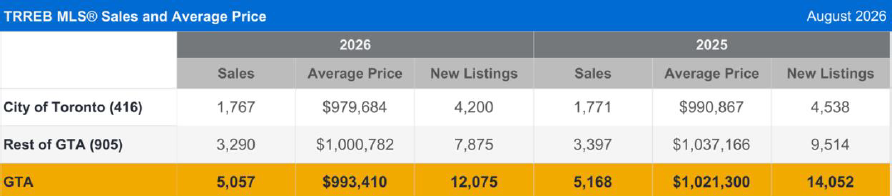
The Greater Toronto Area (GTA) housing market moved through August with the quieter pace typical of late summer, but the underlying picture was more stable than the headline numbers suggest. The Toronto Regional Real Estate Board (TRREB) reported 5,057 home sales, down 2.1 per cent from August 2025. New listings fell much more sharply, down 14.1 per cent year over year to 12,075, while active listings ended the month at 24,482, down 11.3 per cent. The pullback in supply helped keep the market broadly balanced even as buyers remained cautious.
The average GTA selling price was $993,410, down 2.7 per cent from a year earlier and below $1 million for only the second month in 2026. We need to consider this number with care because it combines all property types and geography across the region. The raw average price declined from July, but TRREB reported that it edged higher after seasonal adjustment. The MLS Home Price Index benchmark, which better tracks the value of a typical home, was $925,900, 4.5 per cent lower year over year and essentially flat from July on a seasonally adjusted basis. Together, these measures point to monthly stabilization rather than a broad change in direction.
“If inventory tightens and home prices begin to rise, some buyers may face a trade-off between waiting for greater economic certainty and purchasing before prices move higher. At the same time, improving market conditions for sellers could bring more listings to market, providing buyers with additional choice,” said Toronto Regional Real Estate Board (TRREB) President Daniel Steinfeld.
Market conditions continued to favour careful negotiation rather than strong pricing power on either side. The unadjusted sales-to-new-listings ratio was 41.9 per cent and the market held approximately 4.8 months of inventory, both consistent with balanced conditions. Homes sold for an average of 97 per cent of list price and took 35 listing days to sell, compared with 33 days a year ago. Buyers therefore retained time to compare options, while sellers still needed to align pricing and presentation with current conditions.
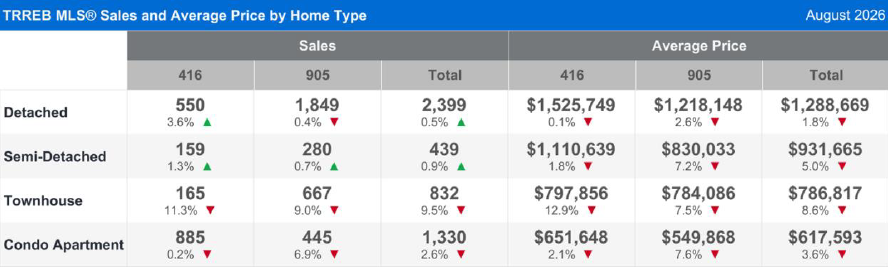
Results varied notably by housing type. Detached homes showed the greatest price resilience, averaging $1,288,669, virtually unchanged from July and roughly 2 per cent below a year earlier. Condominium apartments averaged $617,593, with 1,330 sales representing more than one-quarter of all GTA transactions, which plays into the average overall price of homes stated earlier. Townhouse categories experienced greater price and sales pressure. These differences reinforce that the GTA is not moving as one market. Location, property type, condition and price point continue to shape outcomes.
The City of Toronto held up somewhat better than the surrounding 905 region. Toronto recorded 1,767 sales in August, essentially unchanged from a year earlier, while new listings declined 7.4 per cent to 4,200 and active listings fell 9.5 per cent to 8,727. The city average selling price was $979,684, approximately 1 per cent below last August, while the benchmark price of $918,400 was 3.7 per cent lower. Toronto’s shallower average-price decline supports the broader conclusion that the city was more resilient than many markets outside the 416.
Condominium apartments accounted for half of all Toronto transactions, with 885 sales at an average of $651,648. The city also recorded 550 detached-home sales at an average of $1,525,749, 159 semi-detached sales averaging $1,110,639 and 165 townhouse sales averaging $797,856. Detached and semi-detached activity held up comparatively well, while the townhouse segment was softer. The range of outcomes makes neighbourhood and property-specific analysis more useful than the citywide average alone, particularly for distinctive or higher-value homes.
“Ownership housing in the GTA has remained relatively affordable over the past year, with average prices dipping and mortgage rates remaining somewhat flat. Recent news on the overall economy and job creation has been positive. The main hold-back for many households has been concerns around trade with the United States and the potential for higher inflation and borrowing costs in the future,” said TRREB’s Chief Information Officer Jason Mercer.
The fall market will depend on whether the decline in inventory continues and whether buyers gain confidence in the economic outlook. The Bank of Canada held its policy rate at 2.25 per cent on September 2, but inflation concerns and higher bond yields have limited the prospect of immediate relief in fixed mortgage rates. Nationally, August sales slipped 0.7 per cent from July while the national benchmark price was unchanged, confirming that Toronto’s pause is part of a broader period of stability rather than an isolated correction.
For sellers, this remains a market in which accurate pricing, strong preparation and a clear understanding of the immediate neighbourhood are essential. For buyers, there is still meaningful choice and room to negotiate, although declining inventory could increase competition for the best properties. If sales stabilize while available listings continue to contract, price declines should narrow. However, a more sustained recovery will require greater confidence in borrowing costs, employment and the broader economy.