



Signs of Stabilization Amid Cautious Activity
The Greater Toronto Area (GTA) housing market continued to adjust through February, reflecting a period of recalibration rather than a dramatic shift in direction. While the early months of the year typically signal the beginning of the spring market, activity in 2026 has been slower to gain momentum as both buyers and sellers navigate ongoing economic uncertainty.
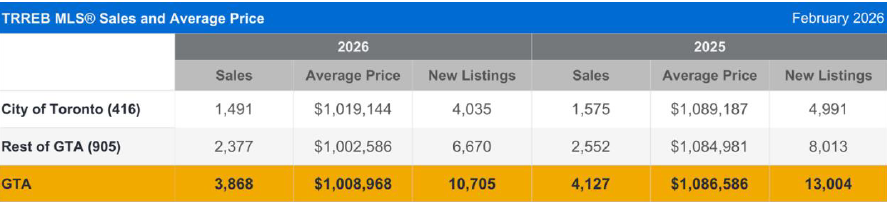
Across the GTA, 3,868 homes sold in February according to the Toronto Residential Real Estate Board (TRREB), representing a 6.3% decline compared with the same month last year. At the same time, new listings dropped even more sharply, down 17.7% year-over-year to 10,705 properties, highlighting a market where both buyers and sellers remain cautious.
“Many would-be homebuyers are waiting for selling prices to level off before moving into the market. If new listings continue to trend lower through the spring, competition between homebuyers will increase, supporting home prices and a recovery in sales,” said TRREB President Daniel Steinfeld.
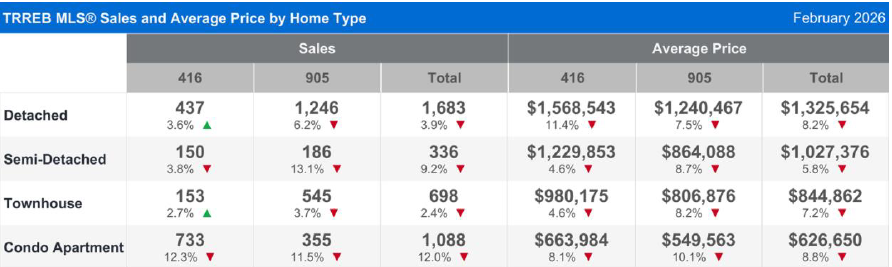
Pricing metrics continued to reflect the adjustment underway. The average selling price in the GTA was $1,008,968 in February, approximately 7% lower than February 2025, while the MLS® Home Price Index benchmark declined 7.9% year-over-year. These broader statistics tell only part of the story, however, as performance continues to vary significantly depending on location, property type, and the quality of the listing itself.
Interestingly, February also revealed a notable dynamic that may shape the market moving forward: supply is shrinking faster than demand. While some buyers remain hesitant, many homeowners are also delaying their decision to list. This hesitation has led to fewer new properties entering the market and has created what some analysts describe as an “inventory paradox”, a market with both reduced sales activity and reduced supply at the same time.
This dynamic is particularly relevant in Central Toronto neighbourhoods, where housing turnover is naturally limited. Even in slower market cycles, demand for well-located homes tends to remain resilient. Buyers are still actively monitoring the market, revisiting listings, and preparing to move once they feel greater confidence that pricing has stabilized.
Another important feature of the current environment is the large pool of pent-up demand waiting on the sidelines. Industry estimates suggest that more than 100,000 potential buyers across the GTA are currently delaying purchase decisions, largely waiting for greater economic certainty and clearer signals that pricing has stabilized.
“There is substantial pent-up demand in the GTA ownership market, with buyers holding off on making a home purchase. Buyers are waiting for selling prices to level off and for positive news on the trade front. Once we see both, there could be substantial momentum driving home sales”, said TRREB Chief Information Officer Jason Mercer.
If listing inventory remains constrained while buyer confidence gradually improves, this dynamic could begin to shift market conditions later in the year. Real estate boards and market analysts are already suggesting that sales activity may strengthen in the second half of 2026, particularly if interest rates stabilize and broader economic conditions improve.
In the meantime, the current market requires a thoughtful and strategic approach. Homes are generally taking longer to sell, and buyers are carefully comparing options before making decisions. Proper pricing, strong presentation, and targeted marketing are therefore more important than ever in ensuring a successful sale. Well-positioned properties, particularly those in desirable neighbourhoods or offering unique characteristics, continue to attract attention and achieve solid results.
Looking ahead, the market appears to be in a transitional phase rather than a downturn. Prices have softened from recent peaks, but underlying demand remains strong, and inventory constraints may ultimately support stability as the year progresses.
As always, it is important to remember that real estate remains highly local. Market conditions can vary significantly from one neighbourhood to another, and from one property type to the next. For homeowners, understanding the nuances of their specific area and property remains the most valuable guide in navigating today’s market.