



January welcomed 2026 with a markedly subdued tone across the Greater Toronto Area (GTA) housing market. According to Toronto Regional Real Estate Board (TRREB), just 3,082 homes traded hands in January, the weakest start to a year in two decades and nearly 20% below January 2025 levels. On a per capita basis, the slowdown is even more pronounced, given the region’s significant population growth over the past twenty years. Sales softened across all major housing categories, reflecting a market still grappling with affordability constraints, employment uncertainty, and cautious consumer sentiment.
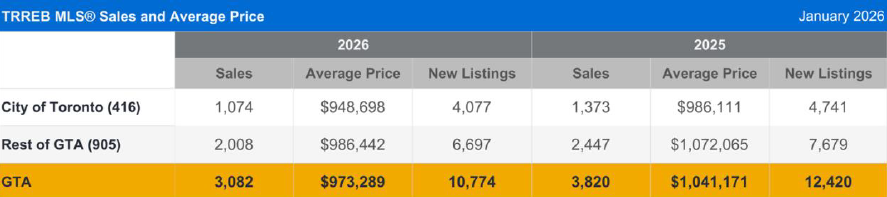
Pricing continues to trend lower, although context is important. The average GTA selling price declined 6.5% year-over-year to $973,289, marking the first time in five years that the average price has fallen below the $1 million threshold. The MLS® Home Price Index benchmark, which measures the value of a “typical” home dropped 8% year-over-year to $936,100, now sitting at its lowest level since early 2021. While these figures signal downward pressure, values remain elevated relative to historical norms, and the improvement in affordability has been incremental rather than transformative.
“With the cost of borrowing flattening out, affordability gains in 2026 will largely be seen on the pricing front, as buyers continue to benefit from negotiating power. A boost in consumer confidence could see buyers move off the sidelines later this year, which could provide support for home prices as market conditions tighten up,” said TRREB Chief Information Officer Jason Mercer.
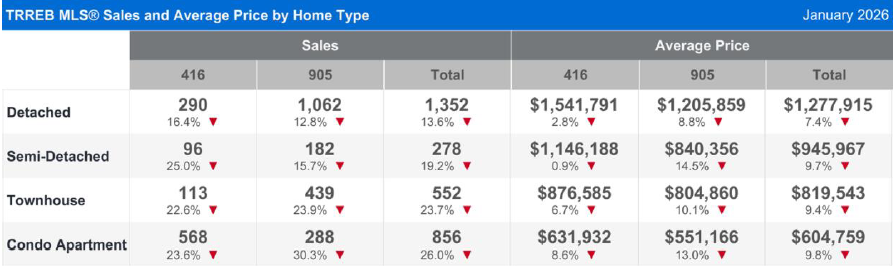
A closer look at property types reveals that condominium apartments continue to weigh heavily on overall averages. In the City of Toronto, more than half of all reported January transactions were condominium sales, with an average price of approximately $631,932. Across the broader GTA, condo apartment prices declined 9.8% year-over-year to $604,759. By contrast, ground-oriented housing has demonstrated greater resilience. Detached homes averaged approximately $1.28 million, while semi-detached and freehold townhomes also posted year-over-year declines but continue to command strong relative demand in select neighbourhoods. Notably, certain micro-markets, particularly well-located semi-detached homes, continue to transact efficiently when priced appropriately, underscoring the importance of hyper-local strategy.
Inventory dynamics further demonstrate the shifting balance of power. While new listings declined by roughly 13% year-over-year, active listings rose to nearly 18,000 homes across the GTA. With listings running at approximately six times monthly sales, the market moved firmly into buyer’s market territory at 5.8 months of supply. Properties are taking longer to sell, and the average sale-to-list price ratio eased to 97%, compared to 99% a year ago. This environment rewards patience, diligence, and strategic negotiation on the buyer side, while requiring thoughtful pricing and positioning from sellers.
Beyond the monthly data, the broader 2026 outlook suggests a market in transition rather than in decline. TRREB forecasts total GTA sales between 60,000 and 70,000 transactions this year, with activity in the first half of 2026 expected to resemble 2025 levels. Average prices are projected to range between $1 million and $1.03 million, with softer year-over-year comparisons early in the year before stabilizing in the latter half, assuming economic conditions improve. Elevated supply levels are anticipated to maintain buyer negotiating power, particularly in the condominium segment.
Consumer sentiment remains the pivotal variable. Ipsos polling indicates that homebuying intentions for 2026 have declined to 22%, five percentage points lower than last year, reflecting ongoing caution despite improved borrowing conditions following prior Bank of Canada rate adjustments. Encouragingly, 45% of intending buyers are first-time purchasers, suggesting that entry-level demand could play a meaningful role in any eventual recovery. Meanwhile, rental demand is expected to remain firm, supported by immigration and an affordability gap that continues to delay many households’ transition into ownership.
” The housing market reflects the tension many households are feeling as we look ahead to 2026. Affordability has improved, but uncertainty continues to weigh on long term decisions like homeownership. Greater economic clarity in the months ahead could restore confidence and help unlock demand that has been building for several years,” said TRREB President Daniel Steinfeld.
In practical terms, January’s results reflect a market defined by choice and negotiation rather than urgency. For well-capitalized buyers, current conditions offer time, leverage, and opportunities not seen in many years. For sellers, success depends less on timing the market and more on precision, realistic pricing, compelling presentation, and targeted marketing within specific buyer segments.
As we look ahead, 2026 is shaping up as a year of recalibration. Confidence has not yet fully returned, but neither has the underlying demand disappeared. When economic clarity improves and sentiment shifts, the significant pent-up demand that has accumulated over the past several years may begin to reassert itself. The months ahead will likely reward those who approach the market with discipline, informed strategy, and a long-term perspective. It’s a great time to start discussing how to translate these shifting conditions into your winning plan.