



A Tighter Market Begins to Take Shape
The Greater Toronto Area (GTA) real estate market entered the second half of 2026 with a subtle but important shift underway. While July brought the expected seasonal moderation in activity, the decline in homes coming to market was considerably greater than the change in sales. This reduced the amount of competition among sellers and moved the market toward a more balanced position, although buyers continue to retain a good degree of choice and negotiating leverage.
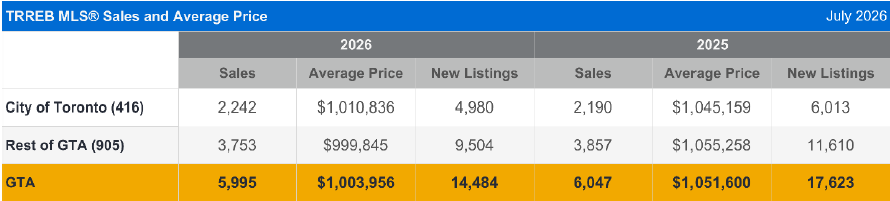
The Toronto Regional Real Estate Board (TRREB) reported 5,995 residential sales in July, a modest 0.9 per cent decrease from the same month last year. New listings, however, fell much more sharply, declining 17.8 per cent year-over-year to 14,484. Active listings also decreased to 26,098, approximately 12 per cent below July 2025. On a seasonally adjusted basis, sales increased from June while new listings declined, indicating that market conditions tightened during the customary summer slowdown.
“With sales accounting for a larger share of listings, buyers may find there is less room to negotiate moving forward. If current trends continue, home prices could start to level off compared to last year. Many would-be homebuyers are waiting for confidence in the market and broader economy to improve before making a purchase. This includes more clarity on tariffs, inflation and borrowing costs.” said TRREB President Daniel Steinfeld.
This contraction in supply is the most significant development in the July figures. After an extended period in which buyers benefited from elevated inventory, many homeowners appear to be delaying their selling plans or withdrawing properties that have not achieved their price expectations. The result is a market with fewer choices for buyers, even though demand has not yet returned to historically normal levels. July’s sales-to-new-listings ratio rose to approximately 41 per cent, compared with about 35 per cent a year earlier, placing the GTA within balanced-market territory but still leaning somewhat in the buyer’s favour.
The average GTA selling price was $1,003,956, down 4.5 per cent from July 2025, while the MLS® Home Price Index benchmark declined by a similar 4.6 per cent to $934,600. The average price also recorded a notable decline from June, although part of this movement reflects normal seasonality and a greater share of lower-priced properties among July’s transactions. Average prices can be particularly sensitive to the types and locations of homes sold in any given month. The more modest movement in the benchmark price provides a clearer indication that underlying values may be approaching greater stability.
The City of Toronto performed somewhat better than the broader GTA. Sales within the city increased 1.7 per cent year-over-year to 2,242, while new listings declined 17.1 per cent and active inventory fell almost 15 per cent. With supply contracting considerably faster than sales, Toronto’s sales-to-new-listings ratio rose to 45 per cent. This suggests that conditions in the 416 are firming more quickly than in many surrounding 905 communities, although results continue to vary significantly by neighbourhood, property type and price range.
“While uncertainty about the economy and borrowing costs persists, recent news has been more positive than expected. The latest readings on economic growth and jobs surprised to the upside. This could help bolster consumer confidence and prompt an uptick in home purchases in the months ahead, especially if home prices stabilize as we move through the fall,” said TRREB Chief Information Officer Jason Mercer.
One of July’s more encouraging developments was the performance of the condominium apartment market. Across the GTA, condominium apartments sold for an average of $636,323, only 2.3 per cent below last year and modestly higher than in June. Within the City of Toronto, condominium sales increased 3.3 per cent year-over-year to 1,054, while the average price declined by a comparatively modest 1.6 per cent to $672,807. Condominiums represented almost half of all City of Toronto transactions during the month, suggesting that improved affordability is drawing some buyers back into this segment. After a prolonged period of elevated inventory and price pressure, the condominium market may be showing early signs of stabilization.
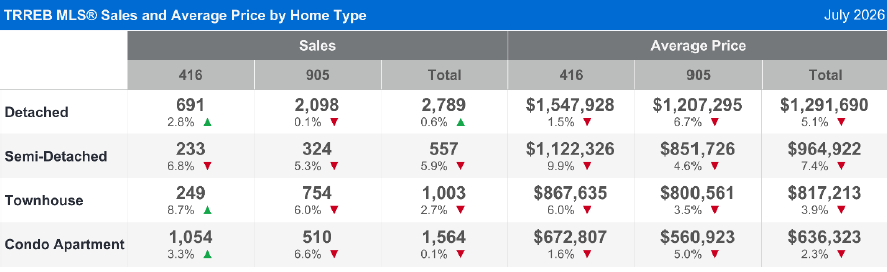
Performance among freehold properties was more varied. GTA detached homes sold for an average of approximately $1.29 million, down 5.1 per cent year-over-year, while semi-detached homes averaged roughly $965,000, a decline of 7.3 per cent. Freehold townhomes demonstrated greater price resilience, averaging approximately $904,000, just 2.7 per cent below July 2025. In Toronto’s more desirable central and eastern neighbourhoods, well-positioned semi-detached properties continued to attract strong interest, showing how the broad regional statistics can mask competitive conditions within individual market segments.
Despite the improvement in the supply-demand balance, buyers have not lost all of their leverage. GTA properties sold for an average of 97 per cent of their asking price and required approximately 45 days to sell when relistings were included. Properties that are well presented, correctly priced and situated in sought-after locations can still generate strong interest, but the market remains highly selective. Sellers whose expectations are not aligned with current conditions may face longer marketing periods or the need to adjust their pricing strategy.
Borrowing costs and economic confidence will continue to influence the pace of recovery. The Bank of Canada maintained its overnight rate at 2.25 per cent in July, noting that the Canadian economy remained soft but was showing signs of improvement. While mortgage affordability continues to restrain purchasing power, greater stability in interest rates, employment and consumer confidence could encourage more sidelined buyers to re-enter the market.
Looking ahead, the fall market will provide a clearer indication of Toronto’s direction. If new listings remain constrained while sales hold near current levels, the year-over-year decline in benchmark prices should continue to narrow, and conditions could gradually become more favourable to sellers. If a substantial number of deferred listings return after Labour Day without a corresponding increase in demand, buyers will regain greater choice.
July did not mark a broad price recovery, but it did offer evidence that the market is moving away from the excess-supply conditions seen earlier in the year. The most likely progression is stabilization before meaningful growth. In this increasingly segmented environment, successful outcomes will continue to depend on a detailed understanding of local conditions, thoughtful preparation and a pricing strategy tailored to the specific property rather than the market averages alone.